One of the first questions B2B buyers ask after receiving a quotation is: “How long will production take?”
There is no single answer for every custom wooden product.
A simple laser-cut ornament may be produced relatively quickly, while a wooden display stand with printing, painting, hardware and assembly requires more processes. Order quantity, material availability and packaging can also affect the final schedule.
Understanding the production stages makes it easier to plan launches, seasonal orders and promotional projects.
There Is No Single Lead Time for Every Wooden Product
For many relatively simple custom wooden products, bulk production may take approximately 7–15 working days after the sample and all specifications are approved.
More complicated products may require around 15–30 working days or longer.
These are only general reference ranges. Actual lead time depends on the product and factory schedule.
A flat laser-cut ornament and a multi-layer wooden display stand should not be expected to have the same production time, even if the order quantity is similar.
Typical Timeline for Custom Wooden Crafts
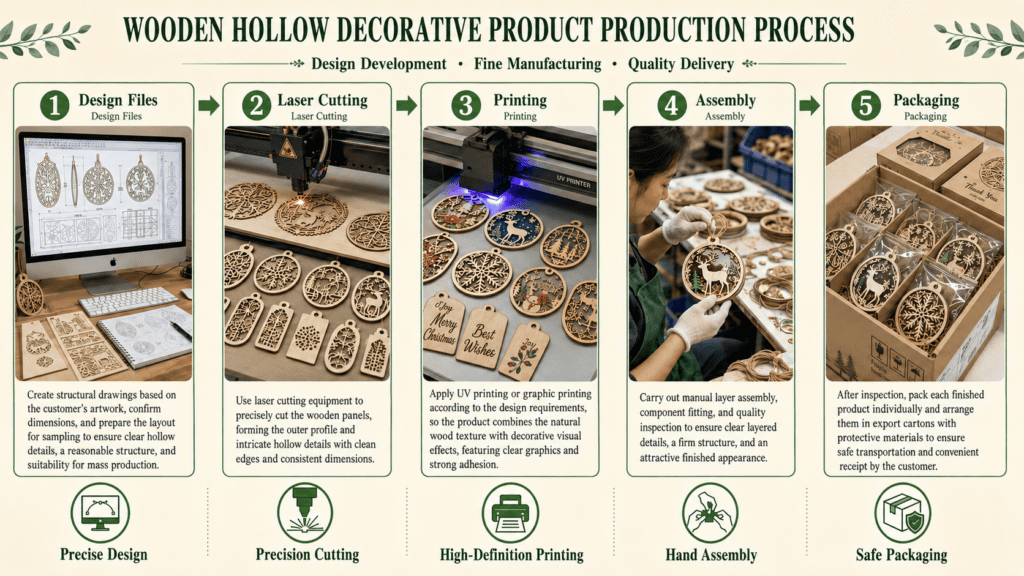
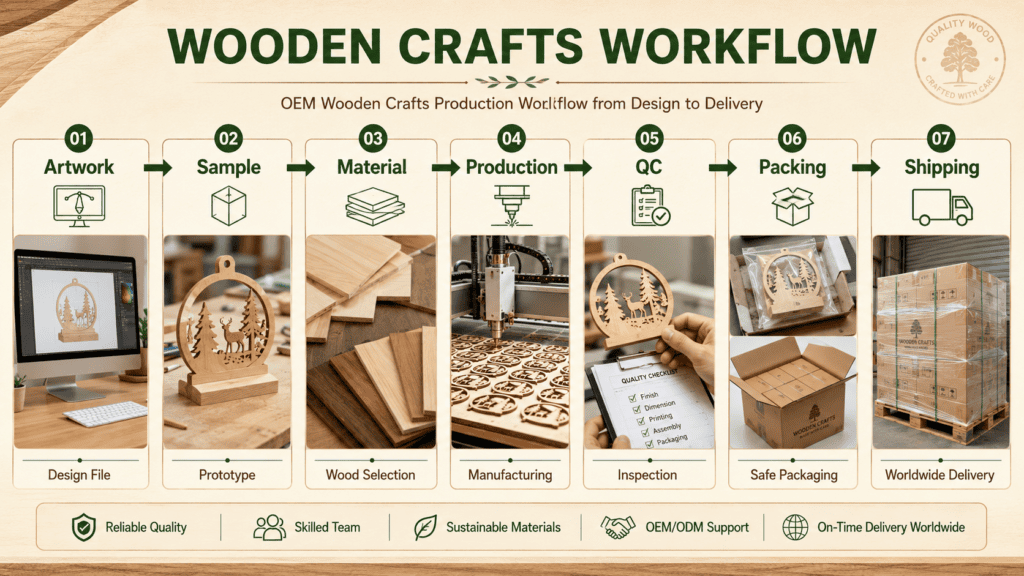
A custom project normally goes through several stages:
- Artwork and specification confirmation
- Sample development
- Material preparation
- Cutting, engraving or printing
- Surface finishing
- Assembly
- Quality inspection
- Packaging
Each additional process adds time to the schedule.
1. Artwork and Specification Confirmation
Production should not begin until the key specifications are confirmed.
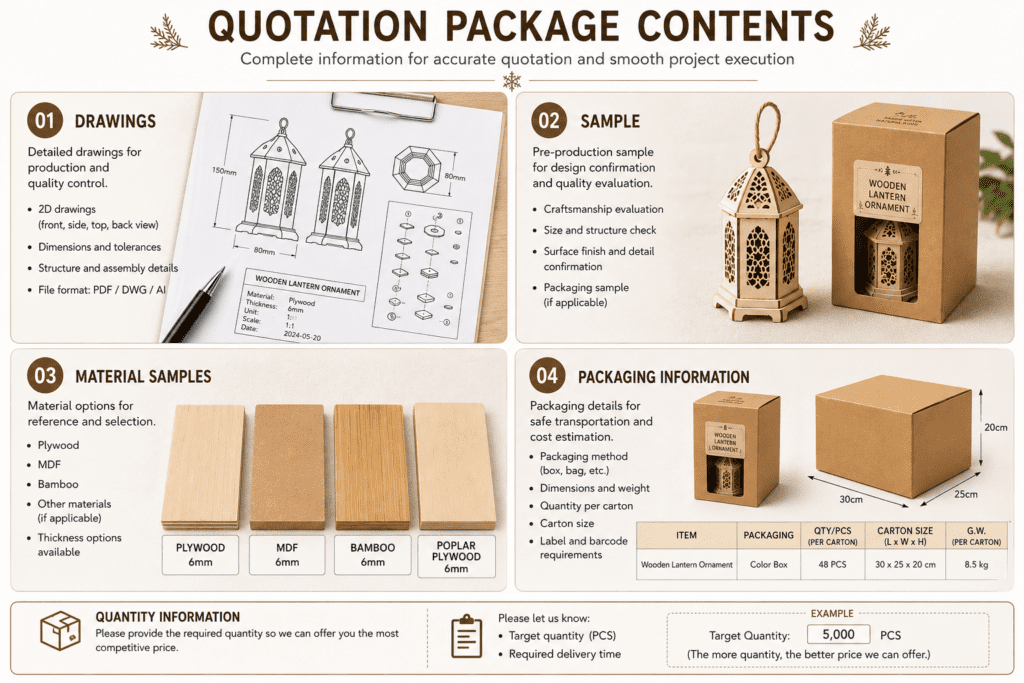
These normally include:
- Product dimensions
- Material
- Thickness
- Artwork
- Engraving or printing
- Quantity
- Packaging
- Colour requirements
If these details keep changing, the production schedule will also move.
Providing final artwork and clear dimensions before sampling is one of the easiest ways to reduce delays.
Related Articles
Proper artwork preparation is essential for accurate laser cutting and engraving. Learn the recommended file formats, design requirements, and common mistakes to avoid before sending your files for production.
How to Prepare Artwork Files for Laser Cutting and Engraving →2. Sample Development
For a new custom product, a physical sample is usually recommended before mass production.
Simple laser-cut samples may take around 3–7 working days after the files and materials are confirmed.
More complicated samples involving painting, multiple components, custom structures or assembly may require 7–15 working days or longer.
The timeline also depends on how quickly the buyer reviews the sample.
Several rounds of design changes can easily add days or weeks to the project.
Related Articles
Every custom wooden craft begins with a sample. Understanding the development process, costs, and lead time helps ensure smoother production and fewer revisions.
Sample Development for Custom Wooden Crafts: Cost, Time, and Process →3. Material Preparation
Common plywood or MDF thicknesses may already be available in stock.
Special materials can take longer.
Examples include:
- Unusual plywood thicknesses
- Specific solid wood species
- FSC-certified material
- Custom-coloured boards
- Special hardware
- Custom ribbons or accessories
If a project requires a material that must be specially ordered or produced, this preparation time should be included before mass production starts.
4. Laser Cutting, Engraving, and Printing
Laser cutting time depends on more than the number of pieces.
A simple shape with a short cutting path is much faster than a detailed design containing dozens of holes and internal cut-outs.
Production time may be affected by:
- Cutting length
- Material thickness
- Number of components
- Engraving area
- Number of printed colours or surfaces
- Front and back processing
UV printing can also require additional setup when an order contains many different designs.
For example, 5,000 identical magnets may be easier to schedule than 5,000 magnets divided into 50 different artwork versions.
5. Painting, Finishing, and Drying
Natural unfinished wooden products usually require fewer processing steps.
Painted or coated products take longer because they may require:
- Sanding
- Primer
- Painting
- Drying
- Additional coating
- Final surface inspection
Drying time cannot always be shortened simply by adding more workers.
This is particularly important for painted wooden boxes, solid wood products and items requiring several finishing layers.
6. Assembly and Manual Work
Manual assembly can become one of the main production bottlenecks for complex products.
Products requiring more labour include:
- Wooden display stands
- Multi-layer decorations
- Boxes
- DIY kits
- Products with screws or hardware
- Products combining wood and acrylic
- Individually personalized products
A single flat wooden piece can move quickly from cutting to packing.
A product containing ten or twenty components must be sorted, checked, assembled and sometimes tested before packaging.
7. Quality Inspection and Packaging
Production is not finished when the machines stop.
The products still need inspection and packing.
Depending on the project, quality checks may include:
- Dimensions
- Cutting quality
- Engraving
- Printing position
- Colour
- Surface finish
- Assembly
- Accessories
- Personalization
- Packaging quantity
Custom retail packaging, instruction sheets, barcode labels and individual boxes can also increase packing time.
For B2B orders, this stage should be included in the quoted production lead time rather than treated as an afterthought.
What Can Make Production Take Longer?
Common causes of delays include:
- Artwork changes after sampling
- Special materials not in stock
- Large numbers of different designs
- Complex manual assembly
- Painting and drying
- Customized packaging
- Third-party testing
- Peak-season production
- Very large order quantities
- Late approval from the buyer
Seasonal orders are especially important.
Christmas, Ramadan, weddings, school seasons and major promotional campaigns can create concentrated production demand. Buyers should place these orders earlier than normal.
How Order Quantity Affects Lead Time
Larger orders usually take longer, but the relationship is not always proportional.
Producing 10,000 pieces does not necessarily take ten times as long as producing 1,000 pieces because material cutting and machine production can be arranged in batches.
However, manual processes such as sanding, gluing, assembly and individual packaging still require significant labour.
This is why two products with the same quantity may have very different lead times.
How Buyers Can Shorten Production Time
Buyers can help reduce unnecessary delays by preparing clear information before ordering.
The most useful steps are:
- Provide final dimensions
- Send production-ready artwork
- Confirm materials early
- Approve samples quickly
- Collect revision comments into one document
- Confirm packaging before mass production
- Avoid changing specifications after production starts
- Tell the supplier the required delivery date at the inquiry stage
For repeat orders, keeping the same approved design, material and packaging normally makes production much faster.
Production Time vs Shipping Time
Production lead time and delivery time are not the same thing.
For example, a supplier may quote 15 working days for production, but the buyer must still allow time for international transportation.
Shipping time depends on:
- Destination country
- Express, air, rail or sea freight
- Customs clearance
- Final delivery method
For event or seasonal products, buyers should work backwards from the date the goods must arrive—not just the date production needs to finish.
What to Tell Your Supplier About Your Deadline
When requesting a quotation, do not only ask, “What is your production time?”
Instead, provide the date when the products must arrive.
Also provide:
- Quantity
- Number of designs
- Packaging method
- Destination country
- Required arrival date
This allows the manufacturer to evaluate both production and shipping schedules.
Jinling Craft provides OEM and ODM production for custom wooden decorations, display stands, medals, refrigerator magnets, signs, gifts and other wooden crafts.
If your project has a fixed launch, event or retail deadline, send us your design, quantity, specifications and required delivery date. We can review the production process and suggest a more realistic schedule before sampling and mass production.