One of the most common questions we receive from B2B buyers is simple: “How much does this wooden product cost?”
The difficult part is that two wooden products of similar size can have very different production costs.
The final price depends not only on the amount of wood used, but also on material type, cutting time, engraving, printing, assembly, order quantity, packaging and quality requirements.
Understanding these factors helps buyers compare quotations more accurately and avoid unexpected cost changes later in the project.
Why Similar Wooden Products Can Have Different Prices
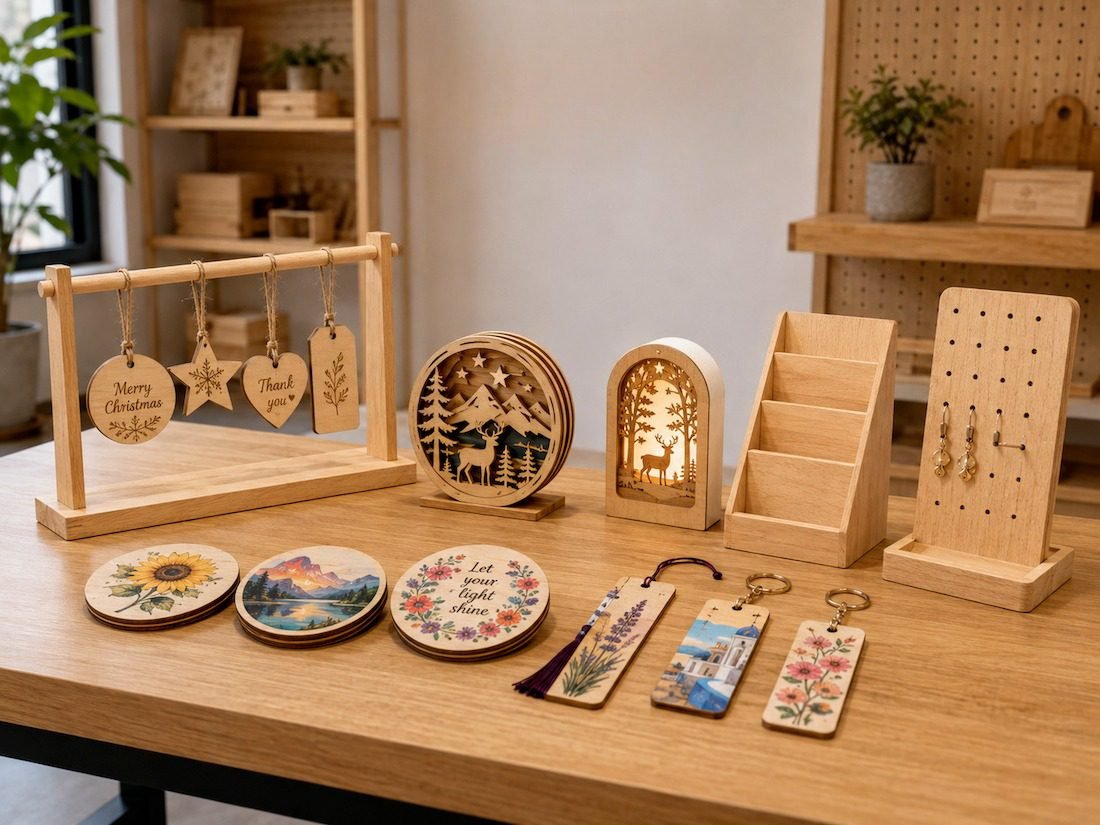
A simple 10 cm wooden ornament may only require one piece of plywood and a short laser-cutting cycle.
Another product of the same size might have three layers, colour printing, engraving, sanding and manual assembly.
The outside dimensions may be similar, but the production process is completely different.
For this reason, manufacturers usually need more information than just a reference photo before providing an accurate quotation.
1. Material Type and Thickness
Material is one of the first factors affecting cost.
Common materials include:
- Birch plywood
- Basswood plywood
- MDF
- Bamboo
- Beech
- Pine
- Walnut
- Other solid woods
Plywood and MDF are generally suitable for laser-cut products and can be more economical for volume production.
Solid wood usually costs more and may also require additional machining, sanding or finishing.
Thickness also matters. A 6 mm board normally uses more material than a 3 mm board and may require slower cutting speeds.
Related Articles
If you’re still deciding between plywood and MDF, you may also find this guide helpful.
Plywood vs MDF for Laser Cut Wooden Crafts →2. Product Size and Material Usage
Larger products require more material, but material cost is not based only on total surface area.
The way parts are arranged on a standard sheet also affects material efficiency.
For example, irregular shapes may leave unused spaces between parts. A slightly smaller design that fits the sheet more efficiently may actually reduce the unit cost.
For bulk orders, manufacturers often optimize the cutting layout to reduce waste.
This is especially important for large display stands, wall signs and multi-component products.
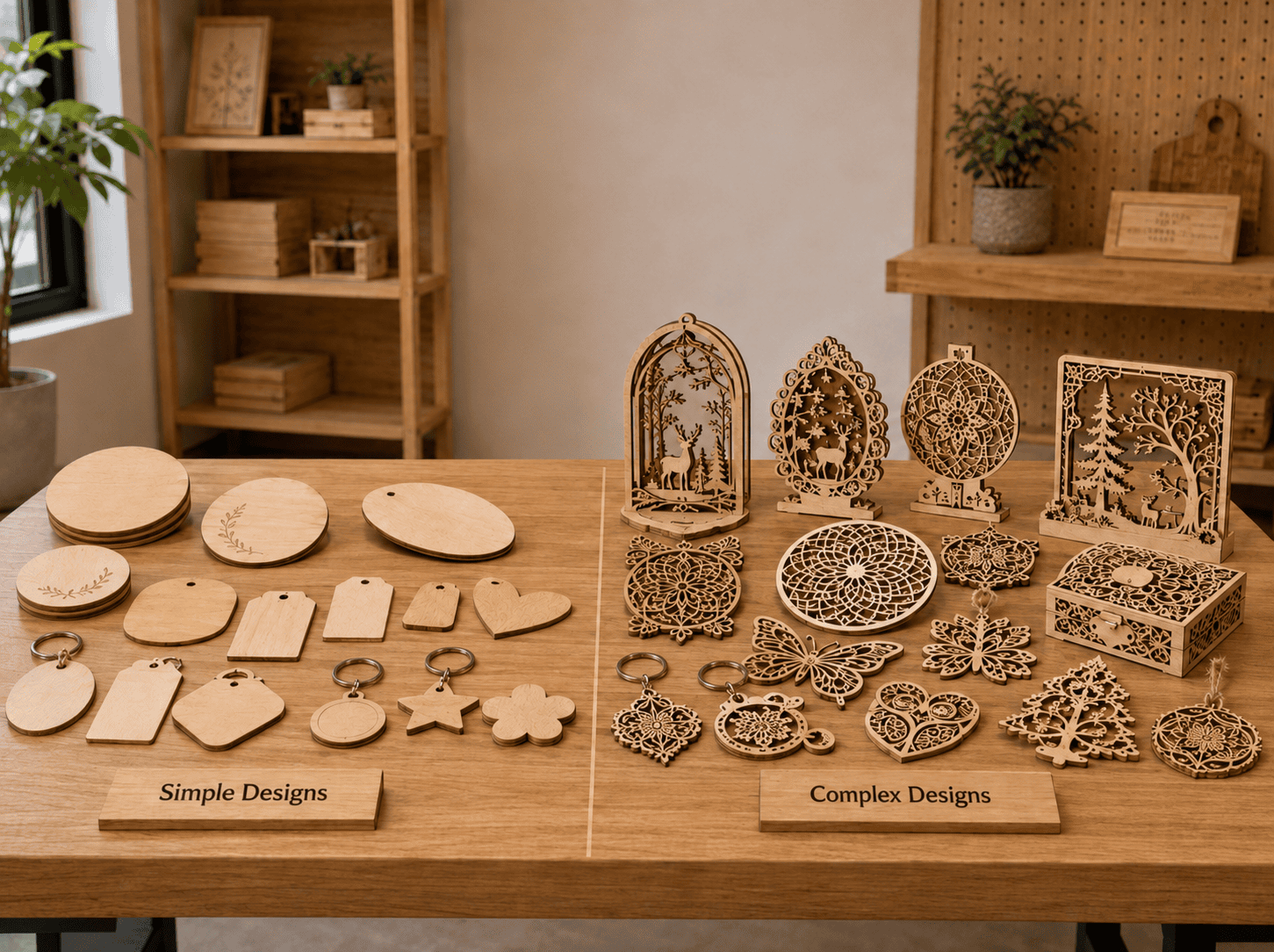
3. Laser Cutting Complexity
Laser cutting cost is strongly related to machine time.
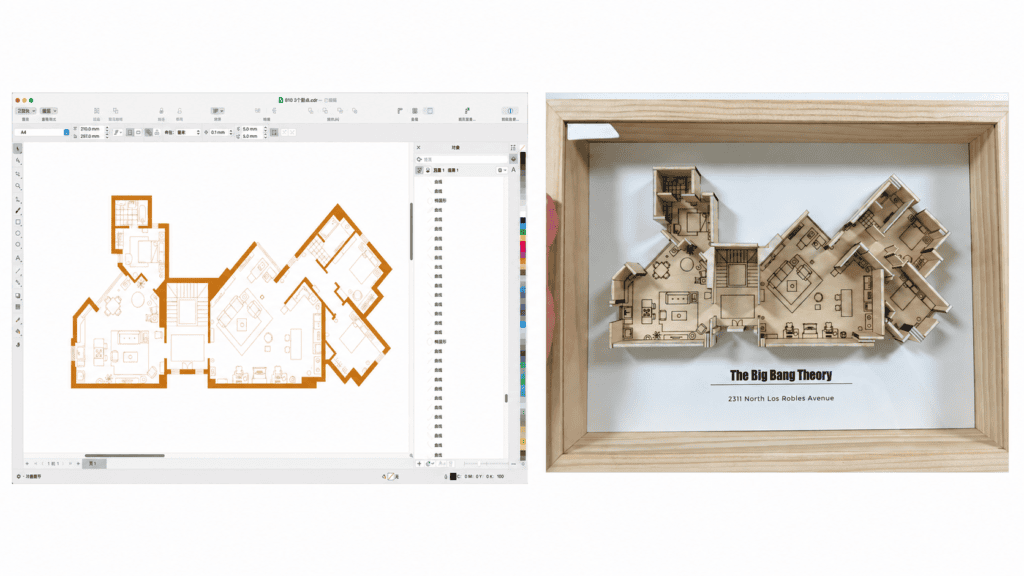
A simple circle can be cut quickly. A detailed tree, map or decorative pattern with many internal shapes takes much longer.
Factors affecting laser cutting time include:
- Total cutting length
- Number of holes
- Internal cut-outs
- Fine decorative details
- Material thickness
- Number of separate components
A highly detailed product may use very little wood but still cost more because the laser machine spends more time cutting each piece.
4. Engraving, UV Printing, and Surface Finishing
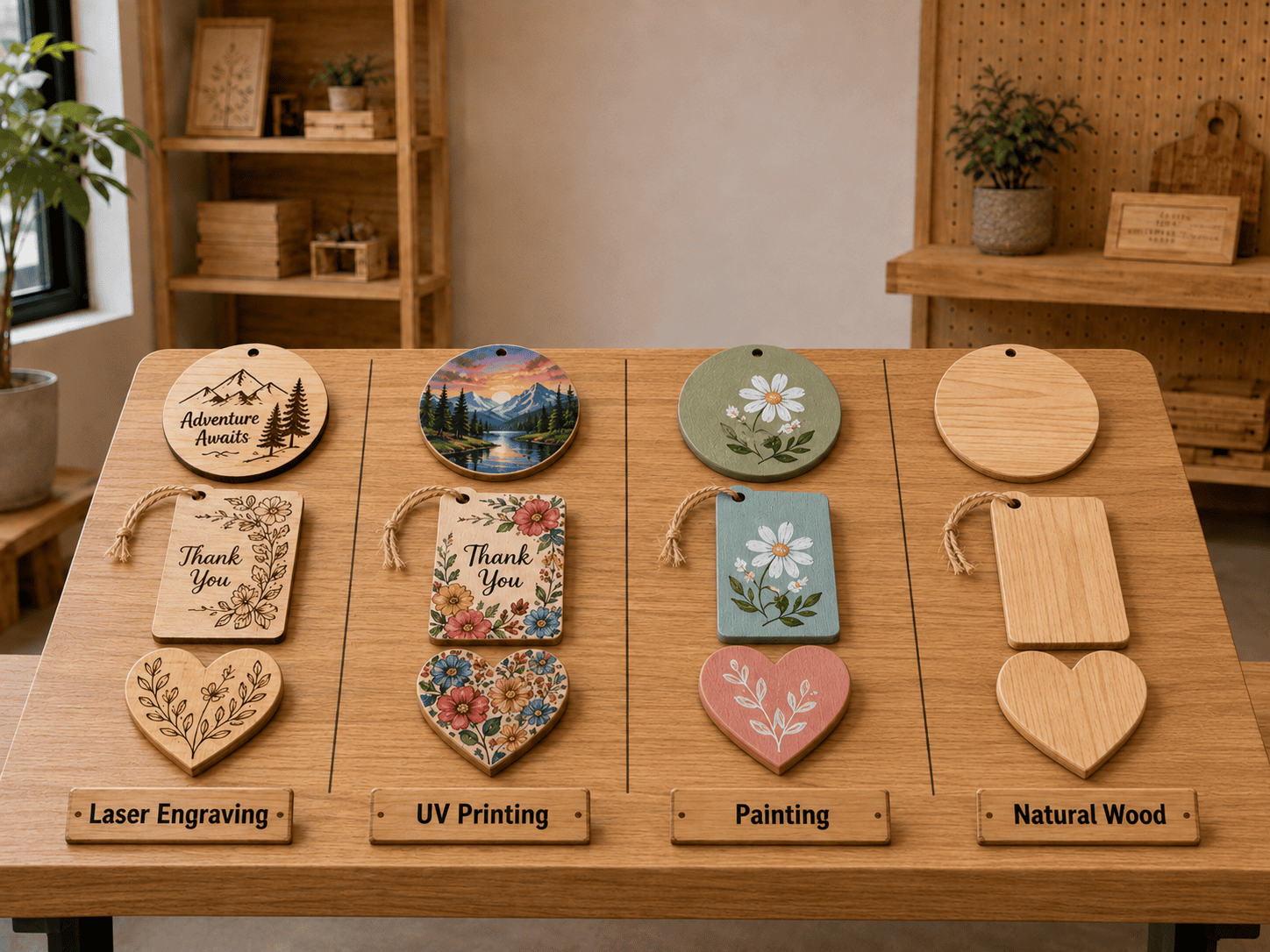
Additional decoration increases production steps.
Laser engraving cost depends on the engraving area and processing time. A small logo is much faster than engraving an entire product surface.
UV printing may include:
- Full-colour graphics
- Logos
- Gradients
- Photographic images
- White ink
- Front and back printing
Surface treatments such as painting, staining, varnishing or protective coating also add material and labour costs.
The more processes required, the higher the production cost generally becomes.
5. Assembly and Manual Work
Labour is another important pricing factor.
Flat laser-cut products require relatively little manual work.
However, products such as:
- Wooden display stands
- Boxes
- Multi-layer wall decorations
- DIY kits
- Wooden toys
- Product holders
may require sanding, gluing, screws, hardware installation or manual assembly.
A product with ten separate parts may require significantly more labour than a single-piece product, even if both use the same amount of wood.
6. Order Quantity and MOQ
Quantity can have a major effect on unit price.
Small orders still require file preparation, machine setup, material preparation and quality checking.
These fixed costs are spread across fewer pieces, which results in a higher unit cost.
With larger orders, production can usually be arranged more efficiently.
For this reason, buyers often see different prices for:
- 100 pcs
- 500pcs
- 1,000pcs
- 5,000pcs
However, the price does not always decrease at the same rate. Some products contain high material or manual labour costs that remain relatively stable even at larger quantities.
7. Custom Packaging
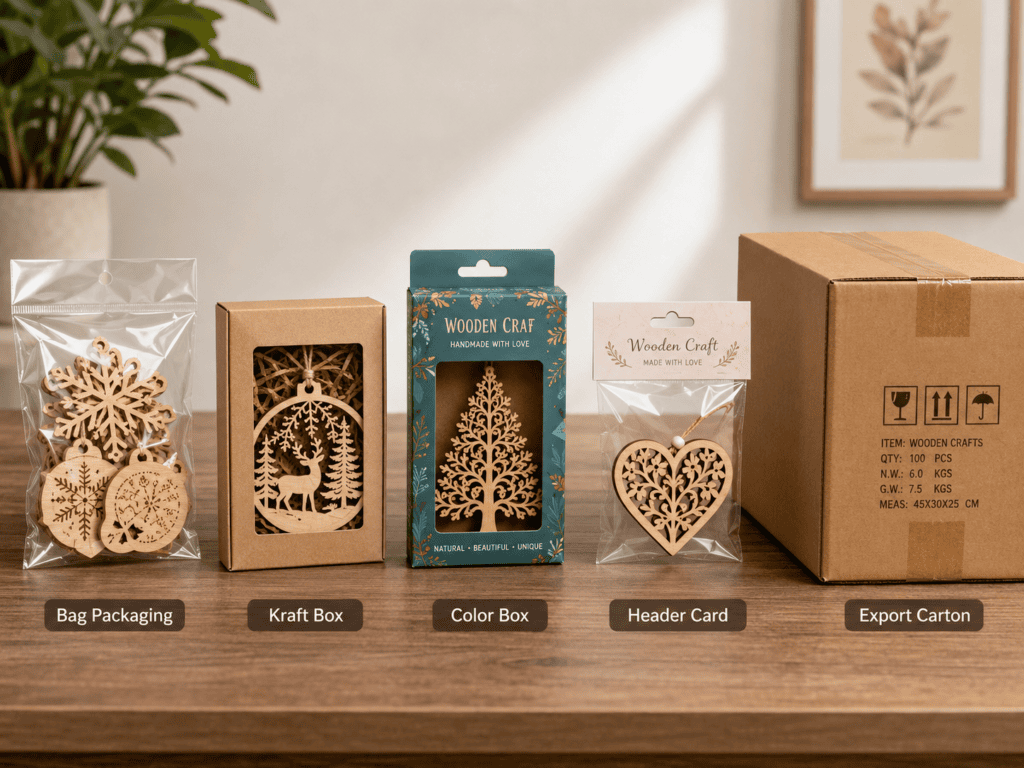
Packaging can range from a simple polybag to a fully printed retail box.
Common options include:
- Polybag
- Kraft box
- White box
- Colour box
- Backing card
- Foam protection
- Cardboard insert
- Instruction sheet
- Barcode label
- Custom logo packaging
For retail or Amazon products, packaging may become a significant part of the total unit cost.
Packaging structure also affects shipping volume, so it should ideally be considered during product development rather than after production is finished.
Related Articles
Learn more about packaging descriptions, you may also find this guide helpful.
Custom Packaging Options for Wholesale Wooden Crafts →8. Sample Development and Design Adjustments
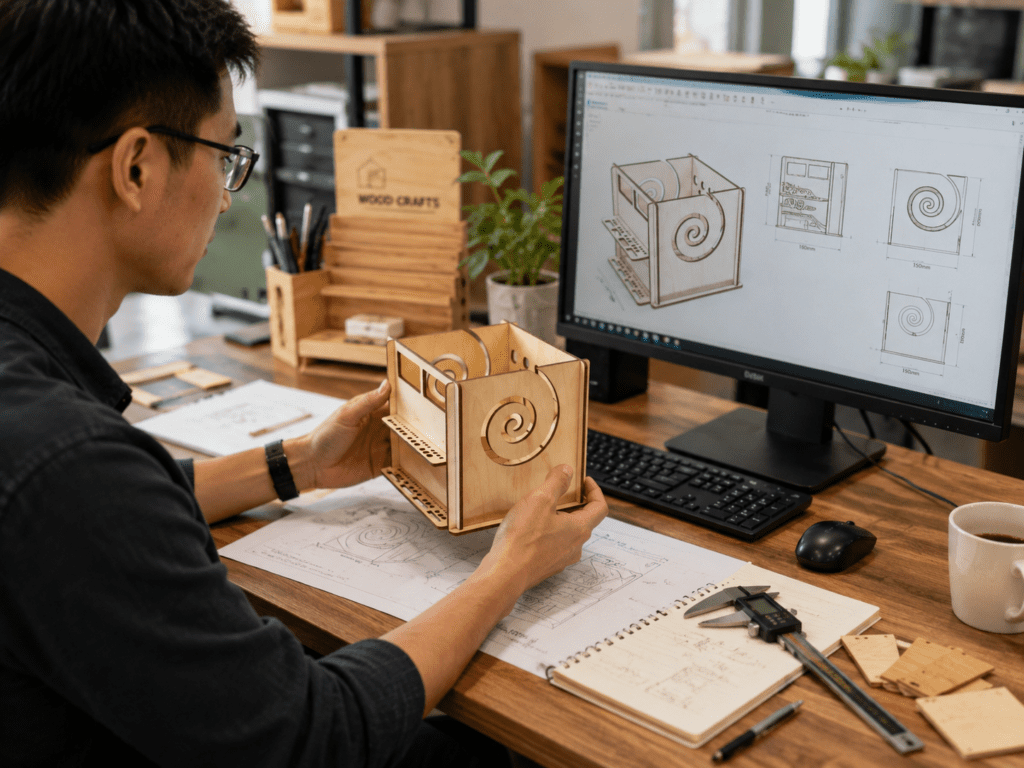
New custom products often require a physical sample before mass production.
Sample cost may include:
- Design file preparation
- Material setup
- Machine setup
- Low-volume production
- Hand finishing
- Assembly
- Packaging testing
A complex new structure may also require several revisions.
Clear drawings and accurate dimensions can reduce unnecessary sample changes and shorten the development process.
Related Articles
Every custom wooden craft begins with a sample. Understanding the development process, costs, and lead time helps ensure smoother production and fewer revisions.
Sample Development for Custom Wooden Crafts: Cost, Time, and Process →9. Quality Requirements and Inspection
Different buyers may have different quality standards.
For example, one project may accept standard laser-cut edges, while another may require additional sanding to reduce visible burn marks.
Higher requirements may include:
- Individual dimension checks
- Colour matching
- Extra sanding
- Surface inspection
- Assembly testing
- Load testing
- Individual personalization checks
- Third-party testing
These additional controls require more labour and may affect the quotation.
10. Shipping and Packing Volume
The factory price is only part of the total sourcing cost.
Shipping is influenced by both weight and carton volume.
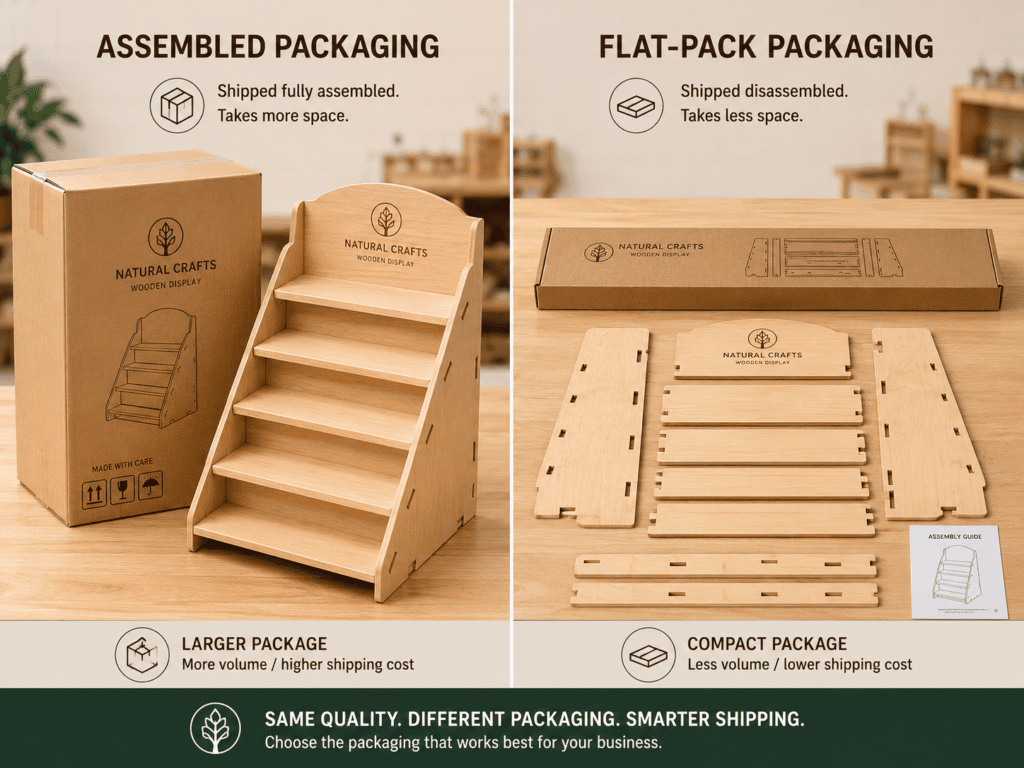
A large assembled wooden display may be inexpensive to manufacture but costly to ship because it occupies a large carton.
Flat-pack structures can often reduce shipping volume significantly.
For this reason, packaging and product structure should be considered together when developing products for international markets.
How to Get a More Accurate Quotation
To receive an accurate quotation, buyers should provide as much information as possible.
Useful information includes:
- Product dimensions
- Material and thickness
- Design file or reference image
- Engraving or printing requirements
- Order quantity
- Number of designs
- Assembly requirements
- Packaging method
- Delivery country
If some details are not yet finalized, the manufacturer can provide an initial estimate and then update the quotation after the design and specifications are confirmed.
Request a Quote for Your Custom Wooden Product
Jinling Craft provides OEM and ODM manufacturing for custom wooden decorations, display stands, refrigerator magnets, medals, signs, gift products and other wooden crafts.
Our production capabilities include laser cutting, engraving, UV printing, CNC machining, sanding, painting, assembly and custom packaging.
Send us your design, dimensions, material preference and estimated quantity. We can review the project and provide a quotation based on the actual production process rather than only the product size.